Quick Recipe Info
- Prep Time: 20 minutes
- Cook Time: 10 minutes
- Total Time: 30 minutes
- Servings: 4
- Calories: ~550 per serving
- Cuisine: Peruvian-Chinese Fusion (Chifa)
- Difficulty: Intermediate
Lomo Saltado Recipe
Ingredients
For the Stir-Fry:
- 1½ lbs beef tenderloin (680g), cut into 1-inch thick strips
- 2 large red onions, cut into thick wedges
- 3 Roma tomatoes, quartered into wedges
- 3 tablespoons soy sauce (45ml)
- 2 tablespoons distilled white vinegar (30ml)
- 1-2 tablespoons ají amarillo paste (15-30ml)
- 4 cloves garlic, minced
- 3 tablespoons high smoke-point oil (45ml) – avocado or peanut
- ½ cup fresh cilantro, roughly chopped
- Salt and black pepper to taste
For the French Fries:
- 1½ lbs Russet potatoes (680g), cut into ½-inch thick fries
- Vegetable oil for frying (about 2 quarts/2L)
- Salt to taste
For Serving:
- Peruvian garlic rice (arroz con ajo)
- Aji verde sauce (optional)
- Lime wedges
Instructions
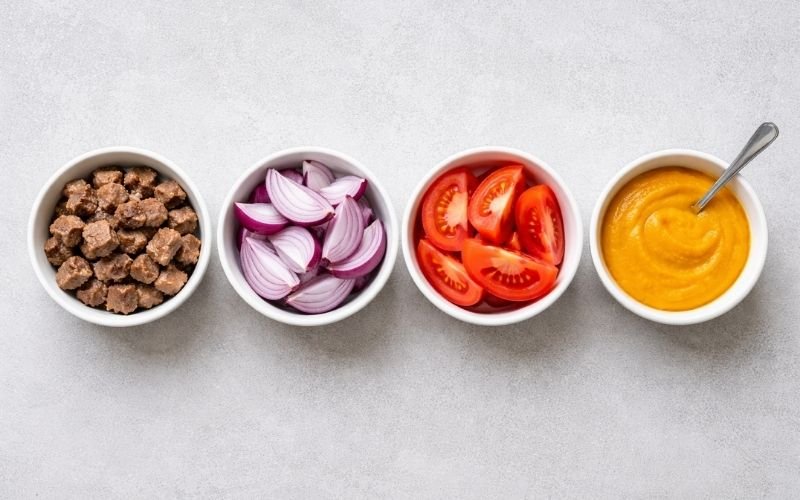
PREP EVERYTHING FIRST: Cut beef into 1-inch strips and pat completely dry. Slice onions into thick wedges. Quarter tomatoes. Measure all liquids into small bowls. Fry potatoes and keep warm in 200°F oven.
1. HEAT THE WOK
Heat wok or largest skillet over highest flame for 3-4 minutes until smoking hot. Add 1 tablespoon of oil and swirl to evenly coat.
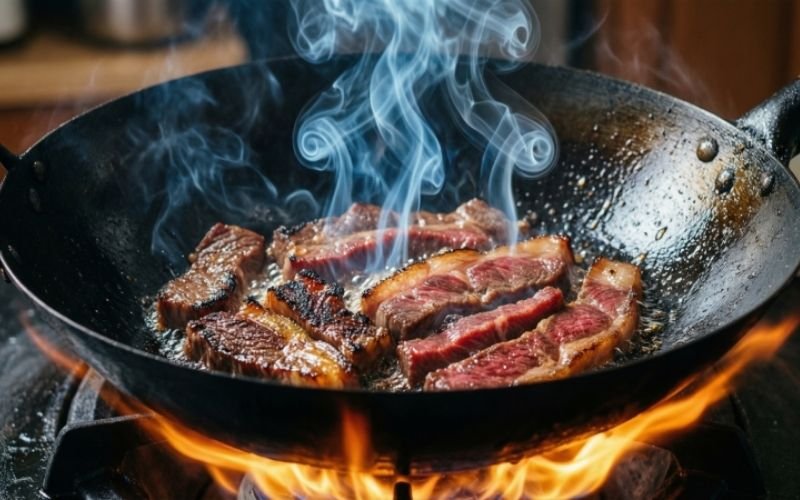
2. SEAR THE BEEF (in 3 batches)
Add one-third of beef to screaming-hot wok. Let sit undisturbed 45-60 seconds. Flip once, sear 30 seconds more. Remove to plate (beef should be rare). Repeat with remaining beef, adding fresh oil between batches.
3. CHAR THE AROMATICS
Add 1 tablespoon oil. Toss in onion wedges and stir-fry 90 seconds until edges char but centers stay crisp. Add garlic, cook 15 seconds.
4. BLISTER THE TOMATOES
Add tomato wedges and stir-fry exactly 60 seconds. They should char but maintain shape.
5. DEGLAZE THE WOK
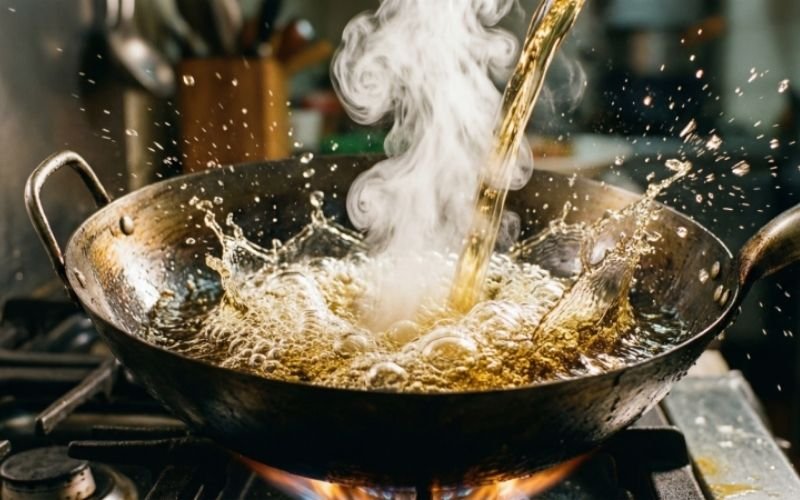
Pour in vinegar and immediately scrape wok’s bottom. Liquid should sizzle and reduce by half in 30 seconds. Add soy sauce and ají amarillo paste, stirring rapidly.
6. TOSS AND FINISH
Return all beef to wok. Toss 30 seconds to coat. Add hot fries and toss 3-4 times quickly. Add cilantro, toss once, and immediately plate. Serve with garlic rice, aji verde, and lime wedges.
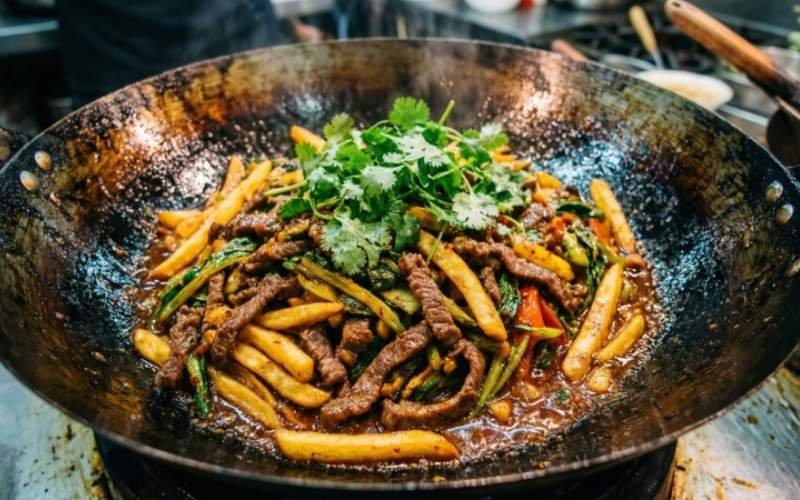
Total Active Cooking Time: 6-8 minutes
Weeknight Shortcut (For Busy Parents)
Skip the double-fry. Use frozen steak fries cooked in an air fryer at 400°F for 15-20 minutes. They won’t be perfect, but they’ll be crispy and save you 30 minutes of prep. Focus your energy on nailing the beef sear that’s where the magic happens.
The Chifa Story: Chinese Migration to Peru
How Two Worlds Collided in Lima’s Kitchens
Between 1849 and 1874, approximately 100,000 Chinese laborers arrived in Peru under the coolie trade system. Most came from Guangdong province’s impoverished coastal regions, seeking escape from the Opium Wars’ devastating aftermath and economic collapse.
These immigrants faced brutal conditions on sugar plantations and guano islands. But when their contracts ended, many migrated to Lima, opening small restaurants called chifas a Hispanicized version of the Cantonese phrase “chi fan” (吃饭), meaning “to eat rice.”
The Birth of Fusion Cuisine
Chinese cooks faced a fundamental challenge: traditional ingredients were unavailable or prohibitively expensive. Soy sauce arrived sporadically. Bok choy didn’t grow in Peru’s climate. Wonton wrappers required wheat flour that cost more than local alternatives.
So they improvised brilliantly. They found that ají amarillo peppers delivered heat similar to the fresh chilies back home, with a fruity complexity appreciated in Cantonese cuisine. They found Peru’s beef superior to anything available in coastal China. And they adapted stir-frying techniques to local cast iron pans when proper woks were unavailable.
Why Lomo Saltado Became Peru’s Soul Food
By the early 20th century, chifa restaurants had evolved from immigrant enclaves into mainstream Peruvian dining. The cuisine appealed across class lines affordable enough for workers, sophisticated enough for middle-class families.
Lomo saltado emerged during this golden era, sometime in the 1920s or 1930s. The addition of French fries already popular in Lima thanks to European immigration transformed it from Chinese stir-fry into something uniquely Peruvian.
Today, Peru has more chifa restaurants per capita than Chinese restaurants exist in most Western cities. This isn’t exotic ethnic food it’s what Peruvians eat when they want comfort, celebration, or simply a damn good meal.
The Anatomy of Lomo Saltado: Why Each Element Matters
The Beef provides your canvas. Thick strips develop a caramelized crust while maintaining juicy, medium-rare interiors living in that precious zone where beef releases its most complex flavors.
Red Onions act as flavor mediators. Their sharpness cuts beef’s richness while natural sugars caramelize under high heat into something almost jammy.
Tomatoes provide crucial acidic counterpoint. Under extreme heat, surfaces char while interiors release just enough liquid to create the dish’s signature light sauce.
French Fries make this uniquely Peruvian. Tossed directly into the stir-fry, they absorb savory juices while maintaining essential crunch textural complexity that transforms this into a complete meal.
Understanding Wok Hei: The Science of the Sear
Wok hei literally “breath of the wok” is the smoky, charred essence separating transcendent stir-fries from merely good ones.
At temperatures exceeding 750°F, the Maillard reaction accelerates dramatically. Proteins and sugars undergo rapid transformation, creating hundreds of new flavor compounds in seconds.
This is why high heat is non-negotiable. Without sustained temperature, you cannot achieve proper caramelization or that signature smoky depth.
The Maillard Reaction: Deep Science of Beef Browning
What Actually Happens at the Molecular Level
The Maillard reaction isn’t one chemical process it’s thousands of simultaneous reactions between amino acids and reducing sugars. When beef hits a 750°F wok surface, the meat’s surface temperature spikes to 300-350°F within seconds.
At this threshold, proteins denature rapidly. The tightly coiled amino acid chains unwind, exposing reactive sites that weren’t previously accessible. Simultaneously, residual glycogen in muscle tissue (the meat’s stored sugar) breaks down into glucose and fructose.
These amino acids and sugars collide in the heat, forming unstable intermediate compounds called Amadori products. These immediately rearrange into hundreds of flavor molecules: pyrazines (nutty, roasted notes), furans (caramel-like sweetness), thiazoles (meaty depth), and aldehydes (the characteristic “grilled” aroma).
Tenderloin vs. Sirloin: How Muscle Composition Changes Browning
Beef tenderloin contains approximately 2.5-3% intramuscular fat and minimal myoglobin (the protein responsible for red color). Its fine muscle fiber structure means more surface area per gram of meat.
During the Maillard reaction, tenderloin’s lean composition produces a cleaner, more delicate brown crust. The low fat content means fewer lipid oxidation reactions those secondary processes that create richer, more complex “beefy” flavors.
The advantage? Tenderloin browns evenly and rapidly. In 45-60 seconds, you achieve complete surface caramelization without overcooking the interior. The crust forms a protective barrier, sealing in moisture while the center remains at a perfect 125-130°F (medium-rare).
The disadvantage? Less intramuscular fat means fewer amino acids released during cooking. Tenderloin relies heavily on the Maillard reaction happening on its surface and on the wok hei compounds from the oil and sauce to develop complexity.
Top sirloin contains 4-6% intramuscular fat and significantly higher myoglobin concentrations (hence its deeper red color). The coarser muscle fiber structure means less surface area, but the muscle has been more heavily worked during the animal’s lifetime.
This mechanical stress creates subtle micro-tears in muscle fibers where amino acids accumulate. When sirloin hits high heat, these concentrated amino acid pockets produce more intense Maillard browning deeper mahogany crusts with pronounced savory notes.
The higher myoglobin content also contributes. As myoglobin denatures above 300°F, it breaks down into smaller compounds that participate in Maillard reactions, adding metallic-mineral notes that read as “beefy richness.”
Additionally, sirloin’s fat renders during the sear, releasing fatty acids that undergo their own thermal reactions. These lipid oxidation processes create lactones (creamy, coconut-like notes) and short-chain aldehydes (grilled meat aroma) that tenderloin cannot produce in equivalent quantities.
The Temperature Window: Why Precision Matters
The Maillard reaction accelerates exponentially between 280-330°F. Below 280°F, reactions proceed too slowly you’ll overcook the interior before achieving proper crust. Above 350°F, you risk burning, which creates acrid compounds (polycyclic aromatic hydrocarbons) that taste bitter.
This is why wok temperature is everything. A properly heated wok maintains 750°F+ bulk temperature. When you add room-temperature beef, the contact surface drops to approximately 320-340°F the sweet spot.
If your wok is only at 500°F (common with home stoves on medium-high), adding beef drops the surface to 240-260°F. At these temperatures, the Maillard reaction barely occurs. Instead, you get pale, steamed meat that releases moisture faster than flavor develops.
The Role of Surface Moisture
Moisture is the Maillard reaction’s enemy. Water on beef’s surface must evaporate completely before temperature can rise above 212°F (water’s boiling point). Every drop of moisture delays browning by 3-5 seconds.
This is why patting beef absolutely dry is non-negotiable. Even a thin water film adds 10-15 seconds to sear time enough to push the interior from rare to medium-well.
Professional kitchens sometimes go further, aging beef strips uncovered in the refrigerator for 1-2 hours. This dehydrates the surface, creating an almost tacky texture. When this hits the wok, Maillard browning begins within 15-20 seconds instead of the usual 30-40 seconds.
The Perfect Fry Problem: Exploring Starch Science and Oil Physics
Understanding Potato Starch Content
Not all potatoes are created equal. The starch-to-moisture ratio determines everything about fry texture.
Russet potatoes (also called Idaho or baking potatoes) contain 20-22% starch and only 2% sugar. The high starch content creates a specific cellular structure: large, loosely packed starch granules surrounded by minimal moisture.
When you cut a Russet into fries and submerge them in 325°F oil, several processes occur simultaneously. First, surface moisture rapidly evaporates, creating tiny steam pockets. Second, starch granules near the surface begin gelatinizing absorbing the escaping moisture and swelling into a gel-like matrix.
This gelatinization is crucial. The starch forms a structural network that supports the fry’s shape even as internal moisture converts to steam. Without sufficient starch, fries collapse into limp, soggy strips.
Third, the low sugar content (2%) means minimal caramelization during the first fry. This is intentional we want structure, not color. Excessive browning during the first fry creates a barrier that traps internal moisture, resulting in fries that seem crispy initially but turn soggy within minutes.
After the first fry, you cool the potatoes for at least 10 minutes (ideally 30). During this rest, the gelatinized starch crystallizes into a rigid structure through a process called retrogradation. The starch molecules realign into tightly packed arrays essentially creating an internal scaffold.
The second fry at 375°F serves a different purpose. The higher temperature rapidly dehydrates the exterior, while the internal starch scaffold prevents collapse. The now-rigid structure allows moisture to escape as steam without compromising texture.
The 2% sugar content also shines here. At 375°F, these minimal sugars undergo caramelization, producing the golden-brown color and subtle sweetness that makes great fries addictive. Too much sugar (like in Yukon Golds) and you get excessive browning fries that look perfect but taste burnt.
Yukon Gold potatoes contain 15-18% starch and 4-6% sugar. The lower starch means a denser cellular structure with smaller, more tightly packed granules.
During the first fry, Yukon Golds gelatinize, but the lower starch content creates a weaker structural network. The fries feel creamy and almost waxy delicious if eating immediately, problematic if they need to withstand the stir-fry’s moisture.
The higher sugar content (4-6%) creates more pronounced Maillard browning during both frying stages. At 325°F, Yukon Golds already start developing color not ideal, as this creates a moisture barrier too early. At 375°F, they achieve beautiful deep golden color quickly, but can tip into burnt territory if you’re not vigilant.
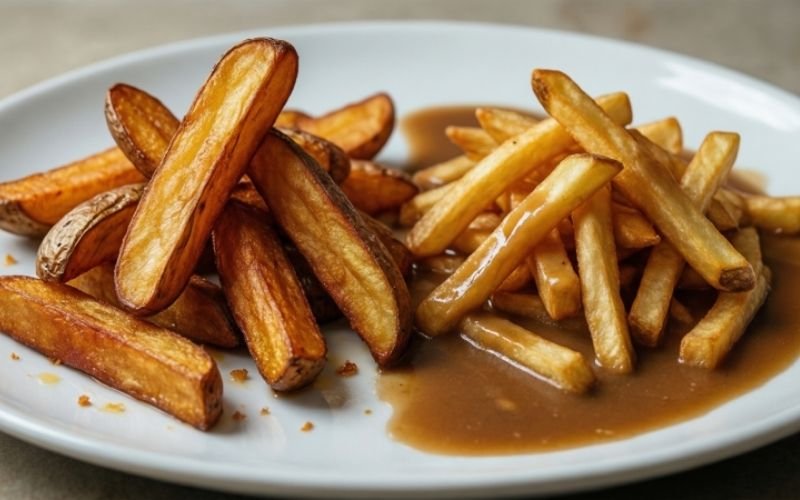
Why Yukon Golds Fail in Lomo Saltado
When tossed into the wok with beef juices, soy sauce, and tomato liquid, Yukon Gold fries absorb moisture rapidly. Their lower starch content means less structural integrity to resist this absorption.
Within 60-90 seconds, Yukon Gold fries in lomo saltado become soggy. The creamy interior that makes them delicious for eating immediately becomes their weakness they lack the rigid starch scaffold that Russets develop.
If you’re eating the dish within 2-3 minutes of plating, Yukon Golds work adequately. But if you’re serving family-style, or if diners eat slowly, Russets are mandatory.
The Physics of Frying Oil
Oil temperature stability determines fry quality as much as potato variety. When you add room-temperature potato strips to hot oil, the oil temperature drops significantly.
First fry at 325°F: Adding 1½ lbs of cold potatoes (about 40°F from soaking in ice water) to 2 quarts of 325°F oil drops the temperature to approximately 280-290°F almost instantly. This is acceptable you want gentle cooking at this stage.
The key is oil recovery time. Cheap vegetable oil in a thin pot might take 2-3 minutes to return to 325°F. During this time, potatoes absorb excess oil while browning unevenly.
Professional-grade peanut or rice bran oil in a heavy Dutch oven recovers to 325°F within 45-60 seconds. The potatoes cook uniformly, take up minimal oil (12–15% by weight compared to 20–25% in low-end setups), and form a proper internal structure.
Second fry at 375°F: The temperature drop is less dramatic because potatoes are already partially cooked and contain less moisture. Adding 1½ lbs of room-temperature par-fried potatoes to 375°F oil drops temperature to approximately 350-360°F.
This is ideal. At 350-360°F, surface dehydration occurs rapidly while the Maillard reaction and sugar caramelization create that golden crust. The oil temperature recovers to 375°F within 30 seconds, finishing the crisping process.
Smoke Point Considerations
Refined peanut oil (smoke point 450°F) is the gold standard for double-frying. It remains stable at 375°F with plenty of thermal headroom. The neutral flavor doesn’t interfere with the fries’ potato taste.
Rice bran oil (smoke point 490°F) offers even more stability and contains natural antioxidants that slow oil degradation. You can reuse rice bran oil 3-4 times versus 1-2 times for vegetable oil.
Vegetable oil blends (typically soybean or canola, smoke point 400-450°F) work acceptably but degrade faster. After 15-20 minutes at 375°F, these oils begin breaking down, producing off-flavors and acrylamide (a potential carcinogen formed when oils break down at high heat).
Avoid olive oil (smoke point 325-375°F depending on refinement). Even refined olive oil sits right at the edge of its smoke point during the second fry. The oil breaks down, producing bitter flavors and excessive smoke.
The Double-Fry Timeline
First fry: 4-5 minutes at 325°F until potatoes are cooked through but pale (no color). Internal temperature reaches 205-210°F, ensuring complete starch gelatinization.
Rest period: Minimum 10 minutes, ideally 30-60 minutes at room temperature. During this time, starch crystallization occurs. You can refrigerate for up to 4 hours, but bring back to room temperature before the second fry (cold potatoes drop oil temperature too dramatically).
Second fry: 2-3 minutes at 375°F until deep golden brown. Internal temperature reaches 215-220°F, dehydrating the exterior while the crystallized starch structure prevents collapse.
Critical timing: Fries are at peak crispness for 15-20 minutes after the second fry. After 30 minutes, even Russets begin losing crispness as ambient humidity slowly rehydrates the surface.
This is why the fries must be the last thing you prepare and why they go into the wok only in the final 10 seconds of cooking.
Pro Tips for Success
Choosing Your Beef Cut
Tenderloin (Traditional)
Most tender cut with buttery texture. Less fat means less flavor relies on marinade and wok hei for complexity. Cooks rapidly, unforgiving if overcooked.
The fine muscle fiber structure means more surface area per gram, creating more opportunity for Maillard browning. Best choice if you’re confident in your high-heat technique.
Sirloin (Budget-Friendly)
More flavor, coarser fibers. Slice against the grain perpendicular to muscle fibers. Higher myoglobin gives deeper color and mineral notes.
The increased intramuscular fat (4-6% versus tenderloin’s 2.5-3%) means richer Maillard browning with more complex flavor compounds. Best choice for maximum beef flavor.
Flank Steak (Flavor Powerhouse)
Intense beefy flavor, long coarse fibers. Slice ultra-thin (1/4-inch max) strictly against grain. Absorbs marinades exceptionally well.
The heavily worked muscle structure creates concentrated amino acid pockets that produce exceptional Maillard browning. Best choice if you’re willing to invest time in precise knife work.
Ribeye (Rich Rebel)
Generous marbling creates richness during high-heat cooking. Fat releases amino acids intensifying umami. Trim exterior fat, preserve interior marbling.
The high fat content (8–12% intramuscular) drives extensive lipid oxidation alongside Maillard browning, maximizing flavor complexity but increasing the risk of flare-ups.
The Vinegar & Soy Chemistry
Distilled white vinegar (5% acetic acid) instantly vaporizes on scorching wok surfaces, creating steam that loosens caramelized proteins. This deglazing action captures browned bits and redistributes concentrated flavor.
Its clean acidity doesn’t compete it provides pure sour notes without added sweetness or fruit undertones. The acetic acid also helps tenderize beef proteins through mild denaturation.
Soy sauce contributes glutamates (amino acids responsible for umami). During fermentation, proteins break down into flavor-enhancing compounds.
Sodium seasons beef while helping retain moisture salt causes protein strands to unwind and trap water molecules through osmosis. Dark soy adds color and subtle sweetness; light soy provides salinity.
Ají Amarillo Options
Fresh Ají Amarillo
Bright, fruity heat (30,000-50,000 Scoville units). Develops slight char when stir-fried, adding smoky complexity. Hard to find outside Peru.
Paste
Concentrates flavor, integrates seamlessly. Quality varies look for minimal additives. Oil content distributes capsaicin evenly throughout the dish.
Dried and Reconstituted
Toast before rehydrating for nutty undertones through Maillard reaction. The sugars in dried peppers caramelize slightly, creating depth paste cannot replicate.
Substitutes
Can’t find ají amarillo? Mix equal parts yellow bell pepper with serrano or jalapeño. Add turmeric for color. Fresno peppers offer similar heat with bright, tangy flavor.
Common Mistakes (And How to Fix Them)
Overcrowding the Wok: Drops temperature below Maillard threshold (300°F). Beef steams instead of sears, turning gray with zero crust. Fix: Cook in small batches. Temperature maintenance beats convenience.
Too Much Liquid: Creates beef soup with soggy fries. Happens from wet beef, overripe tomatoes, or careless measurements. Fix: Dry beef thoroughly. Use firm tomatoes. Measure precisely.
Adding Fries Too Early: They absorb moisture and lose crispness within minutes. Fix: Add fries only in final 10 seconds. Serve immediately.
Reducing Heat Mid-Cook: Fear of smoke prevents proper wok hei and caramelization. Fix: Embrace maximum heat. Open windows, turn on fans, commit to technique.
What to Serve With Lomo Saltado
- Arroz con Ajo (Peruvian garlic rice) – Traditional essential
- Aji Verde (green sauce) – Creamy, spicy counterpoint
- White rice – Simple alternative
- Sliced avocado – Cooling richness
- Lime wedges – Essential brightness
- Peruvian beer – Cusqueña or Pilsen Callao
- Chicha morada – Purple corn drink
Dietary Variations
Keto: Replace fries with roasted radishes or jicama strips. Use coconut aminos for soy sauce. Increase beef portion and ají amarillo.
Whole30: Use coconut aminos, verify ají amarillo paste has no added sugar. Use sweet potato fries, double-fried.
Vegetarian: King oyster mushrooms sliced lengthwise mimic beef’s texture. Alternatively, use thick-cut seitan marinated in soy sauce and garlic. Add smoked paprika for depth.
How to Make Peruvian Garlic Rice
Toast long-grain white rice in oil until translucent (2-3 minutes). Add 6 cloves minced garlic per cup of rice, sauté 30 seconds until fragrant (not browned).
Pour chicken or vegetable stock at 2:1 liquid-to-rice ratio. Bring to boil, reduce to low, cover tightly, steam 18 minutes untouched. Fluff with fork, rest 5 minutes.
How to Make Aji Verde
Blend fresh jalapeños, cilantro, garlic, mayonnaise, queso fresco, lime juice, and ají amarillo paste until smooth. Start with a single jalapeño, tasting before adding more. The mixture should coat a spoon yet still flow easily.
Queso fresco adds tanginess feta substitutes acceptably.
Storage & Reheating
The harsh truth: Lomo saltado’s magic diminishes rapidly. Fries lose crispness within 30 minutes. Beef continues cooking in residual heat.
If storing leftovers, separate components immediately. Refrigerate in airtight containers up to 2 days.
Best reheating method: Discard original fries, cook fresh ones. Reheat beef mixture in smoking-hot wok for 60-90 seconds.
Alternative: Air fryer at 400°F for 3-4 minutes revives original fries somewhat, though they’ll never match fresh.
Nuclear option: Cook fresh lomo saltado. Takes only 15 minutes when prepped, quality difference is astronomical.
Frequently Asked Questions
Can I make lomo saltado without a wok?
Yes. Use the largest, heaviest skillet (cast iron or carbon steel) and heat until smoking hot. Cast iron holds heat better than thin stainless steel. Work in smaller batches flat pans have less cooking surface. Preheat 5 minutes on maximum heat.
What’s the best substitute for aji amarillo?
Mix equal parts yellow bell pepper with serrano or jalapeño. Add turmeric for color. Fresno peppers offer similar heat with bright flavor. Frozen ají amarillo paste is superior to any fresh substitute worth seeking online.
Why is my beef tough?
Three causes: wrong cut selection, improper slicing, or overcooking. For tougher cuts like flank, slice ultra-thin (1/4-inch max) strictly against grain. Beef should be rare to medium-rare after initial sear. Ensure marinade includes acidity (vinegar and soy sauce).
Can I prep ahead for weeknight cooking?
Cut beef strips, slice vegetables, mix liquids up to 24 hours ahead. Store separately in refrigerator. Marinate beef overnight for enhanced flavor and tenderness. Never cook components ahead dish must be cooked immediately before serving. Pre-fry potatoes (first fry only) up to 2 hours ahead, complete second fry before serving.
Is lomo saltado gluten-free?
Not traditionally (soy sauce contains wheat). Replace with tamari or coconut aminos. Verify ají amarillo paste is gluten-free some brands add wheat thickeners. Beef, vegetables, and potatoes are naturally gluten-free. Ensure frying oil hasn’t been used for breaded items.
Quick Reference Guide
| Component | Key Instruction | Common Mistake |
| Beef | Sear in small batches, 45 seconds per side | Overcrowding the pan |
| Heat Level | Maximum flame, smoking hot wok | Reducing heat mid-cook |
| Onions | 90 seconds, crisp-tender with char | Cooking until soft |
| Tomatoes | 60 seconds only, maintain shape | Turning into sauce |
| Fries | Add last 10 seconds, serve immediately | Adding too early |
Ready to create the best lomo saltado of your life? Remember: high heat, organized mise en place, and absolute commitment to technique. Share your results with us at TheForksy.com.
